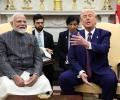
'Trump's aggressive stance towards China and preference for military posturing could shift the Quad's balance towards overt militarisation.'
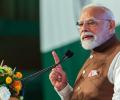
Prime Minister Narendra Modi on Friday said it is important for India and China to work together to bring stability to the world economic order as he asserted that New Delhi is ready to advance bilateral ties from a strategic and long-term perspective based on mutual respect, mutual interest and mutual sensitivity.

The United States has made it clear that its first strategic dialogue with Pakistan next week is not being held at India's expense, even as it said it is 'pleased' that Pakistan army chief Ashfaq Parvez Kayani is part of Islamabad's delegation as there can be no such talks without the military participation.
United States Secretary of State Hillary Clinton will arrive in New Delhi on Monday to attend the second round of Indo-US strategic dialogue on Tuesday during which a host of key bilateral, regional and international issues including situation in Afghanistan and Pakistan and security cooperation in the backdrop of recent Mumbai blasts will be discussed.
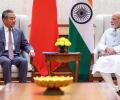
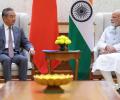
China's Foreign Minister Wang Yi expressed China's anticipation for Prime Minister Narendra Modi's visit to the Shanghai Cooperation Organisation (SCO) summit, emphasizing the importance of strong India-China relations and mutual cooperation.
Shuja Nawaz, arguably the most authoritative expert on the Pakistani military, assesses the US-Pakistan strategic dialogue.
India and the United States will hold the second round of their strategic dialogue in New Delhi on April 6 during which US Secretary of State Hillary Clinton would lead the American side, Foreign Secretary Nirupama Rao has announced in Washington.
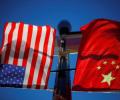
'Trump does have a master plan in mind to put pressure on India with the additional tariff of 25 per cent to get Modi to persuade Russian President Vladimir Putin to freeze the Ukraine war.' 'It has not worked so far. By end-September only we'll know for sure the future trajectory of India's oil purchases from Russia,' observes Ambassador M K Bhadrakumar.
The United States and Pakistan would hold their third ministerial-level Strategic Dialogue in Washington, DC, next week, against the backdrop of America pushing Islamabad to act firmly against terrorist safe havens and step up relief efforts in the wake of the devastating floods in the country

Defence Minister Rajnath Singh says India achieved all objectives of Operation Sindoor, emphasizing that escalating the situation to war with Pakistan was not the aim. He highlighted India's fight against cross-border terrorism and the successful exposure of Pakistan's air defense system.
The second such dialogue is aimed at discussing ways to enhance investments and business engagement between the two of the fastest growing economies, significantly at a time when the western world is in deep crisis.
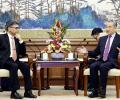
India and China have agreed to rebuild ties and resume people-to-people exchanges, including resuming direct flights and the Kailash Manasarovar Yatra this year. The two countries also discussed the resumption of dialogue mechanisms to address each other's concerns and move relations to a more stable path. The meeting comes after a period of strained relations following the Galwan Valley clashes in 2020.

In reflection of their growing congruence in areas of defence and security, the two sides, following the Modi-Mitsotakis talks, agreed to set up an institutional dialogue at the level of national security advisors, and boost defence industrial cooperation.
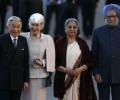
In recent years India-Japan relations have acquired rich economic content and strategic intents. Although the bilateral trade at $18 billion between the two countries is not very impressive and leaves much to be desired, the economic engagement between the two countries is both qualitatively and quantitatively noteworthy. India-Japan defence cooperation, however, has generated a lot interest among the strategic community in the context of rise of China. There has been a lot of speculation about India-Japan strategic partnership to hedge China, says Rup Narayan Das.
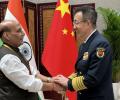
China has called Tibet-related issues a 'thorn' in India-China bilateral relations and a 'burden' for New Delhi, ahead of External Affairs Minister S Jaishankar's visit to China.

India and France are negotiating the deal for buying 26 Rafale Marine jets which are going to be deployed on the INS Vikrant aircraft carrier and different bases.
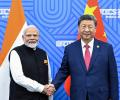
India and China celebrated the 75th anniversary of their diplomatic relations on Tuesday, with leaders from both countries exchanging congratulatory messages. The anniversary comes as the two countries are working to restore ties after a four-year freeze due to the military standoff in eastern Ladakh. Both countries have expressed a willingness to enhance strategic mutual trust and step up cooperation in various fields. The two sides are also exploring ways to rebuild ties and promote people-to-people exchanges.

'I want to request the central government that they should not target someone just for the sake of targeting him if he has not done anything wrong.'

Pakistan on Thursday sought the early resumption of the stalled dialogue process with India but acknowledged forward movement was unlikely before the upcoming Indian general elections.
'New Delhi is not naive about its foreign policy choices.'
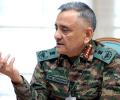
Chief of Defence Staff General Anil Chauhan on Saturday said India's Operation Sindoor has drawn a 'new red line' of intolerance against terror, and expressed hope that the military action has brought 'some lessons for our adversary also'.

India-US relations, like Rome, were not built in a day, nor can they be demolished in a day.
All said and done, when the new global order emerges, India can only remain with the democracies, asserts Ambassador T P Sreenivasan.

Prime Minister Narendra Modi on Thursday said India and Italy have decided to elevate their bilateral ties to a strategic partnership, opening a new chapter on defence cooperation.

India expects partners to understand its policy of 'zero tolerance' against terrorism, and it will never countenance 'perpetrators of evil' being put on par with its victims, External Affairs Minister S Jaishankar said on Saturday during extensive talks with his British counterpart David Lammy.
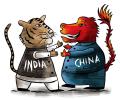
India and China have announced a series of measures aimed at improving their relationship, including maintaining peace along the border, reopening border trade, and resuming direct flights.

The Galwan clashes indicate to the limitations in relations if they do not address border stability, points out Srikanth Kondapalli.
The Galwan clashes indicate to the limitations in relations if they do not address border stability, points out Srikanth Kondapalli.
The 17 rare earth elements that are at the centre of the current crisis are critical components of everyday products -- from cars to jet engines to electronics like smartphones and flat-screen TVs.

In a statement after a meeting between Trump and Pakistan Army chief Asim Munir at the White House on Wednesday, the Inter-Services Public Relations -- the media wing of the Pakistan Army -- said they also discussed joint counterterrorism efforts.
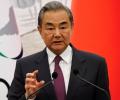
China on Tuesday called for a 'comprehensive and lasting ceasefire' between India and Pakistan, urging both countries to properly handle their differences through dialogue.

'India has gone some way to meeting its objectives because it has established a deterrent value that Pakistan will have to take into account when it plans future terrorist attacks.'
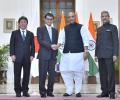
The India-Japan 2+2 dialogue added strategic heft to the special relationship in the wake of growing Chinese assertiveness on regional affairs, points out Dr Rajaram Panda.

The post further read that "at a moment of heightened regional turbulence", President Trump "demonstrated great strategic foresight and stellar statesmanship through robust diplomatic engagement with both Islamabad and New Delhi," Dawn reported.
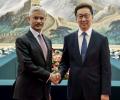
India and China should build on 'good progress' in normalising the bilateral ties to address border-related issues including de-escalation, and it is essential to avoid 'restrictive trade measures and roadblocks', External Affairs Minister S Jaishankar said on Monday during talks with his Chinese counterpart Wang Yi.
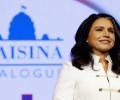
'Pick up momentum and find opportunities from an intelligence-sharing standpoint.'
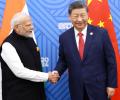
Chinese President Xi Jinping on Wednesday pledged to strengthen the strategic relationships with neighbouring countries by 'appropriately' managing differences and enhancing supply chain ties as China's tariff war with the United States escalated.
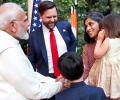
Prime Minister Narendra Modi and US Vice President JD Vance have expressed satisfaction with the progress made in negotiations for a bilateral trade agreement. The two leaders met in New Delhi and discussed a range of bilateral issues, including cooperation in energy, defense, strategic technologies, and other areas. They also exchanged views on regional and global issues of mutual interest.
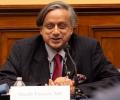
Tharoor said if Pakistan were to dismantle the infrastructure of terrorism, "we can talk to them".

"It is still not too late. India must speak clearly, act responsibly, and use every diplomatic channel available to defuse tensions and promote a return to dialogue in West Asia," Gandhi asserted.

US Secretary of State Michael Pompeo and Defence Secretary Mark T Esper will visit India on October 26 and 27 for the high-level dialogue aimed at further boosting defence, security and global strategic ties between the two countries.
